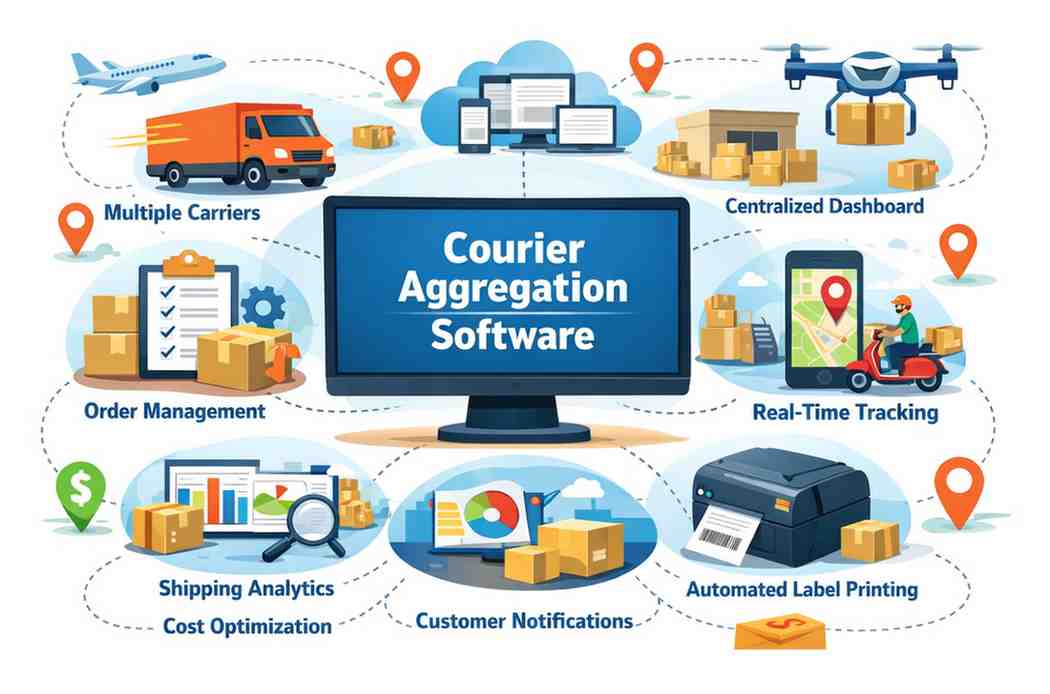
Courier Aggregation Software: The Backbone of Modern Logistics Operations The logistics industry is evolving faster than ever. Customers now expect same-day delivery, real-time tracking, flexible courier choices, and transparent pricing. For businesses trying to meet these expectations, managing multiple courier partners manually quickly becomes inefficient and error-prone. This is where Courier Aggregation Software plays a critical role. Courier aggregation platforms act as a single control layer that connects businesses with multiple courier services, helping them ship smarter, faster, and more cost-effectively. What Is Courier Aggregation Software? Courier aggregation software is a centralized system that integrates multiple courier partners into one platform. Instead of dealing with different dashboards, rate cards, and APIs, businesses can manage all shipping operations from one interface. With Courier Aggregation Software, companies can compare courier rates, allocate shipments automatically, generate shipping labels, track orders in real time, and handle returns efficiently. This consolidation reduces operational complexity while improving service quality. Why Businesses Are Moving Toward Courier Aggregation Modern businesses operate in a highly competitive environment where logistics performance directly impacts customer satisfaction. Delayed deliveries or lack of visibility can damage brand trust. Courier aggregation solves these challenges by offering flexibility. If one courier underperforms in a specific region, shipments can be rerouted through another partner without disrupting operations. This adaptability is especially valuable for ecommerce platforms, marketplaces, and D2C brands. In addition, courier aggregators negotiate bulk rates with logistics providers, allowing businesses to benefit from lower shipping costs without high shipment volumes. Key Features That Drive Operational Efficiency A well-designed courier aggregation platform focuses on automation, visibility, and control. Multi-Courier Integration The system connects with national, regional, and hyperlocal courier partners. Businesses can choose the best courier based on cost, delivery speed, serviceability, or customer preference. Smart Courier Allocation Rules-based allocation automatically assigns shipments to the most suitable courier. Factors such as destination, package weight, SLA, and historical performance are taken into account. Unified Tracking and Notifications Real-time tracking across all courier partners improves transparency. Customers receive consistent tracking updates regardless of which courier is used. Automated Labelling and Documentation Shipping labels, invoices, and manifests are generated automatically, reducing manual effort and minimizing errors. Returns and Reverse Logistics Courier aggregation platforms simplify returns by offering structured reverse logistics workflows, an often overlooked but critical part of customer experience. Business Impact Across Industries Courier aggregation is not limited to ecommerce alone. It supports a wide range of industries with distinct logistics needs. Retailers use aggregation platforms to balance cost and speed during peak sales periods. Healthcare and pharmacy distributors rely on reliable courier allocation for sensitive shipments. Manufacturers and B2B suppliers benefit from better visibility into last-mile delivery. For growing businesses, Courier Aggregation Software also enables scalability. As order volumes increase, the platform adapts without requiring additional manpower or complex system changes. Data-Driven Decision Making One of the most powerful advantages of courier aggregation is access to actionable data. Performance dashboards highlight delivery success rates, delays, courier reliability, and cost trends. This data helps businesses refine their logistics strategy. Poor-performing courier partners can be identified quickly, while high-performing ones receive more volume. Over time, this continuous optimization leads to faster deliveries and better customer satisfaction. Enhancing the Customer Experience From a customer’s perspective, logistics is a major touchpoint with the brand. Late deliveries or unclear tracking often result in complaints and negative reviews. Courier aggregation platforms ensure consistency. Customers experience uniform tracking updates, predictable delivery timelines, and smoother returns. These improvements translate into higher trust, repeat purchases, and long-term loyalty. For customer support teams, centralized shipment data reduces resolution time, allowing faster and more accurate responses to delivery-related queries. Security, Compliance, and Integration Modern courier aggregation solutions are built with enterprise-grade security and compliance standards. Data encryption, role-based access, and audit logs protect sensitive shipment information. Most platforms also integrate seamlessly with ecommerce systems, ERP software, order management systems, and marketplaces. This ensures that logistics workflows align smoothly with broader business operations. Conclusion As logistics complexity continues to grow, businesses can no longer afford fragmented shipping operations. Courier aggregation offers a practical, scalable, and customer-focused solution. By centralizing courier management, reducing costs, improving delivery performance, and enhancing visibility, Courier Aggregation Software becomes a strategic asset rather than just an operational tool. For companies aiming to deliver faster, smarter, and more reliably, adopting courier aggregation is no longer optional. It is a competitive necessity.
